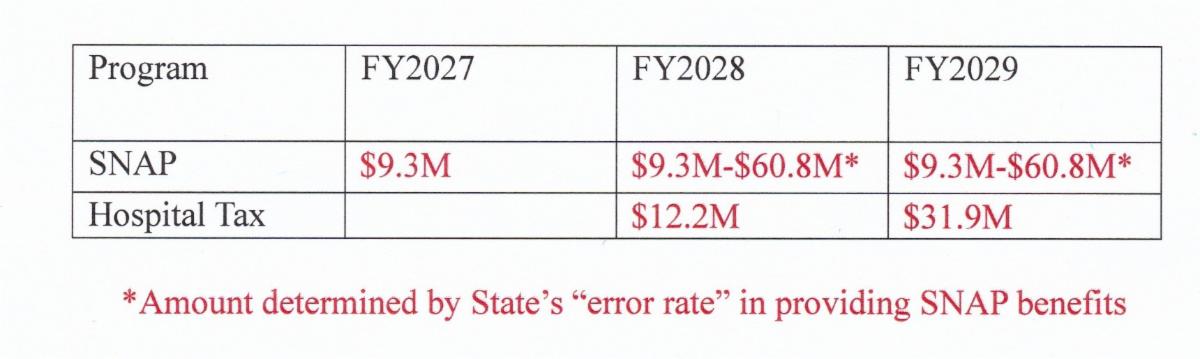
| While these two items are the easiest to quantify, there are many other provisions in HR-1 that will increase the State budget’s costs in future years.
B. The Governor’s Affordability Agenda
In his State of the State address, the Governor described his budget as a response to the affordability crisis, proposing among other measures State-funded health insurance relief ($10 million), initiatives to reduce the State’s “error rate” in SNAP benefits. He also proposes a number of affordability initiatives that are not directly linked to HR-1, including:
· Phasing out the State tax on Social Security
· Reducing the motor fuel tax by two cents
· Changing the child care tax deduction to a refundable tax credit
When fully implemented in the FY2029 budget, these initiatives combined will reduce revenues by $100 million.
To pay for these initiatives, the Governor proposes a “millionaire” tax bracket expected to raise $67 million in the FY2027 budget and $135 million annually thereafter. He also proposes increased cigarette and cigar taxes expected to raise around $8 million annually. Finally, the Governor proposes two one-time measures, namely a tax amnesty expected to raise a one-time $26 million and a partial postponement of a Medicaid reimbursement rate increase that will save over $20 million for one year only.
C. The Tension Between Affordability and Sustainability
As part of the budget, the Governor provided this 5-year forecast of future State budgets. It reveals, even with the greater revenues of a “millionaire tax”, a dramatically expanding gap between revenues and expenses on an unprecedented scale. While some of the sources of this gap are obvious, I plan to spend time in the Senate Finance Committee learning more about the Governor’s model; for example, what assumptions does it make about the State’s ability to reduce the SNAP error rate?
Taking the model at face value, the forecast raises a serious question about the sustainability of our budget, which in turn requires the General Assembly to proceed with caution when considering any new State-based “affordability initiatives” in the Governor’s budget. The tactical decision by the Republican Congress to phase in their agenda provides an opportunity for us, as a State, to look into our future. I am reminded of the story in the Book of Genesis, Chapter 41, in which Joseph interprets the Pharaoh’s dream to predict seven “fat years” (prosperous harvests) followed by seven “lean years” (famine) in Egypt. Based on Joseph’s prediction, Egypt set aside 20% of its grain harvest in each of the seven “fat years” to feed the nation during the seven “lean years” that followed. While many Rhode Islanders are suffering from an “affordability crisis” today, we know that even greater challenges will begin next year, and I believe our decisions about this year’s budget must consider our ability to sustain a response to the greater needs that we will need to address at that time. |