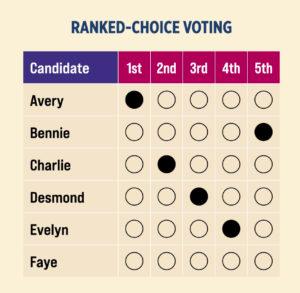
| Once all of the votes have been recorded, they are tabulated in stages. If the first choices of voters yield a majority winner, the contest is over. If not, the first-choice ballots of those who selected the lowest finisher are redistributed to the candidates who were the second choice of those voters. If that yields a majority, the race is decided. If not, the same redistribution occurs of the ballots of the new last-place finisher, continuing in successive rounds until one candidate receives a majority. In this way, the ultimate winner will have gained a form of support from a majority of the voters.
C. Alternative Non-Plurality Voting Systems
In light of my own tenuous first election, I asked Senate leadership to form a study commission on the issue of non-plurality voting. They graciously agreed. The commission ultimately produced this Report. It analyzes a variety of alternative systems, including ranked choice voting. If you have time, the Report contains an extended discussion of the policy advantages and concerns raised by ranked choice voting and other non-plurality voting systems.
At the risk of oversimplifying, the Report concludes that while each of these alternative systems could improve on pure plurality voting in some ways, each also introduces complexities. For ranked choice voting, those complexities included a more elaborate ballot, the need to educate voters and election officials, and the reduced transparency of multi-state vote counting. Many of these complexities can be addressed over time.
D. Trying Out Ranked Choice Voting In The 2028 Presidential Primary
The Senate has considered this issue in different forms over the past few years. This year I introduced S-2590, which would introduce ranked choice voting for the 2028 Presidential primary only. I believe the Presidential primary can provide the best possible “test case” for Rhode Island voters to try out this system for these reasons:
- There is only one set of candidates for voters to rank. This also reduces the complexity of the ballot.
- The candidates will have well-funded campaigns to educate voters about how ranked choice works.
- The election officials will have more than a year to develop their system, and tabulations will only involve two races (one for each political party).
- Given Rhode Island’s likely smaller role in deciding the outcome of the party nominations, it will not be catastrophic if election officials need extra time to complete the tabulation correctly.
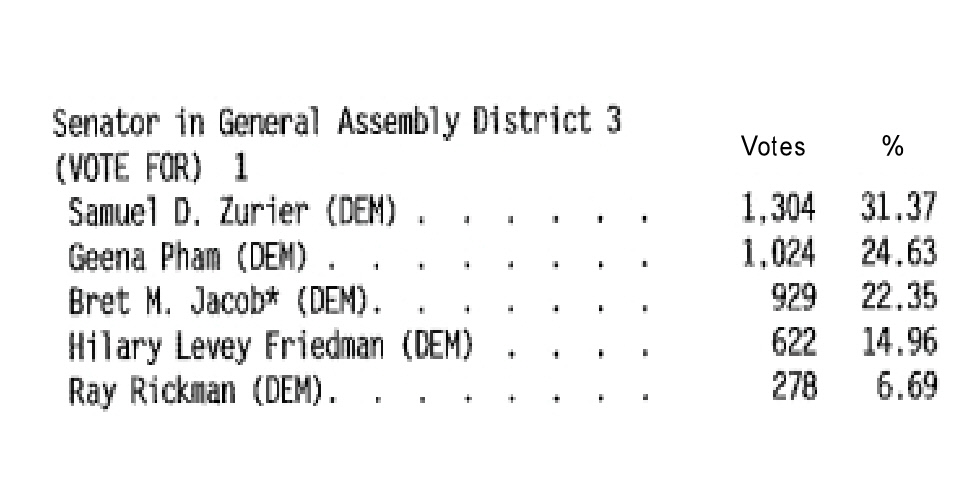
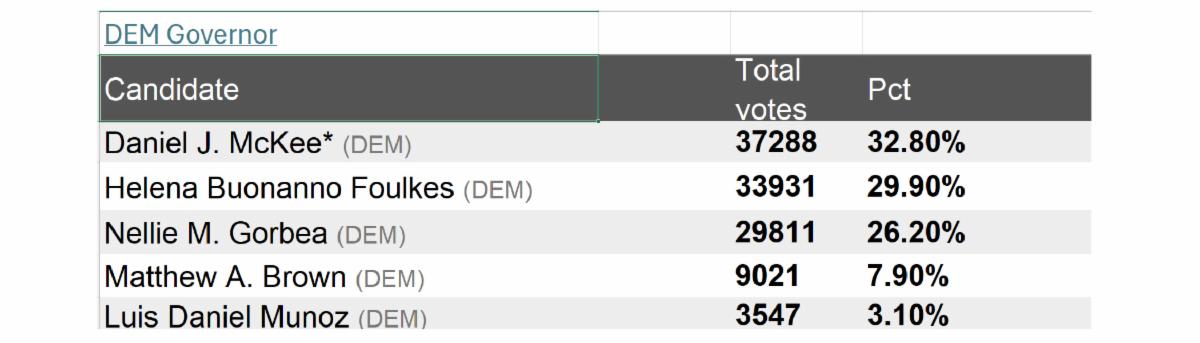
In short, the 2028 Presidential primary could provide Rhode Islanders with a low-risk trial run of this system. Given the weaknesses of our current system, as highlighted both in my own primary election in 2021 and the Democratic gubernatorial primary in 2022, I believe we could have much to gain and relatively little to lose. |